
COMPARATIVE STUDY OF TWO 17TH CENTURY LANDSCAPE PAINTINGS
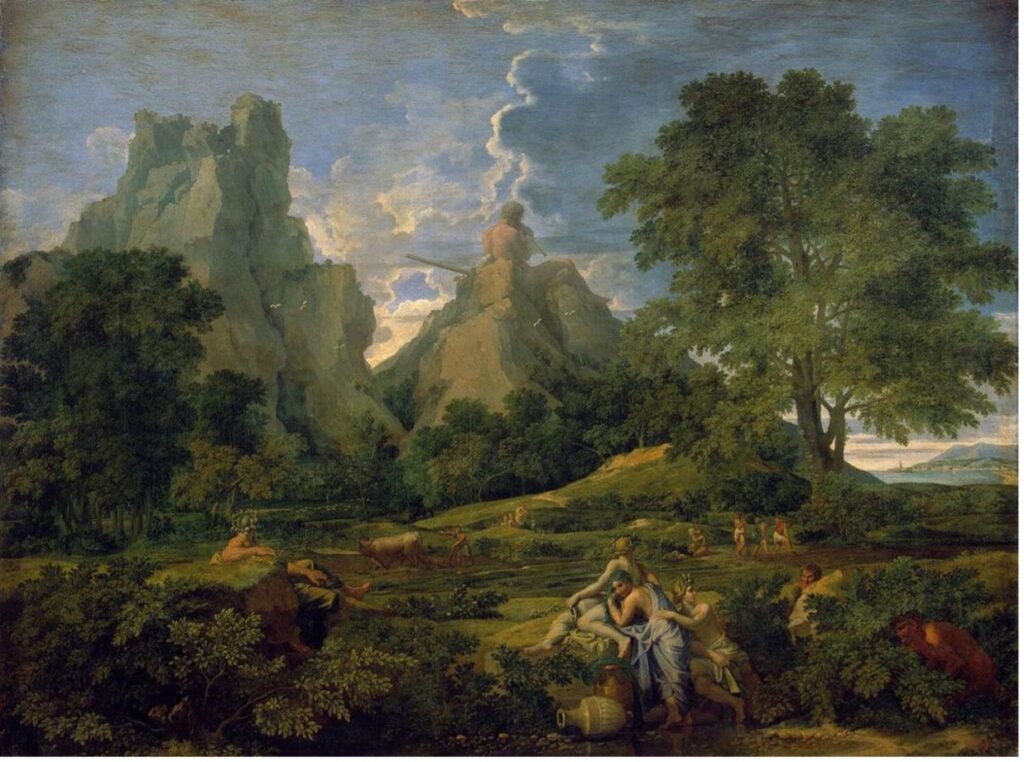
At the beginning of the new era, the question of whom a human is turned into finding a general human theory based on empirical facts and logical conditions. The new heliocentric order becomes the basis of the new anthropology. In Stoic and Christian philosophy, human life is determined by divine providence. In the new system, humans who claim to be at the center of the universe lose their support. She is in the infinite space surrounded by the silent universe, indifferent to her demands. Seventeenth-century philosophers tried to prove that the new cosmology does not challenge the prominent position of reason in humans but reinforces it.
The first philosopher who demonstrated the way to other systems was Giordano Bruno (1548-1600). The characteristic feature of Bruno’s philosophy is the term ‘infinity.’ According to Bruno, infinity is not something hostile or difficult to master, as it was considered in Ancient Greek philosophers. Instead, it is something positive. This view brings new opportunities for human reason.
The motif of Apollo and Sybil hasn’t occurred in painting before the 17th century. Several painters created this motive, even though it is not the most popular one. Some of them were, Etienne Picart (1631-1721), Etienne Allegrain (1644-1736), or Richars van Orley ( 1663-1732). I have chosen to compare two paintings with the same motif.
Lorrain and Rosa’s paintings represent several, typical 17th-century art features such as the interest in landscape and inspiration from classical mythology.
The historical connection of this motive regards the three sources of European culture, such as ancient Greece, Rome, and Christian tradition.
These two 17th-century paintings show the meeting between Apollo and the Cumean Sybil and they are inspired by Ovidiu’s description of this encounter in Metamorphoses
Sibyl tells Aeneas about her meeting with Apollo (Phoebus) and that she is in love with him. She wished to live as many years as sand grains which she held in her hand however she forgot to ask about eternal youth in exchange for accepting Apollo’s love encounter.
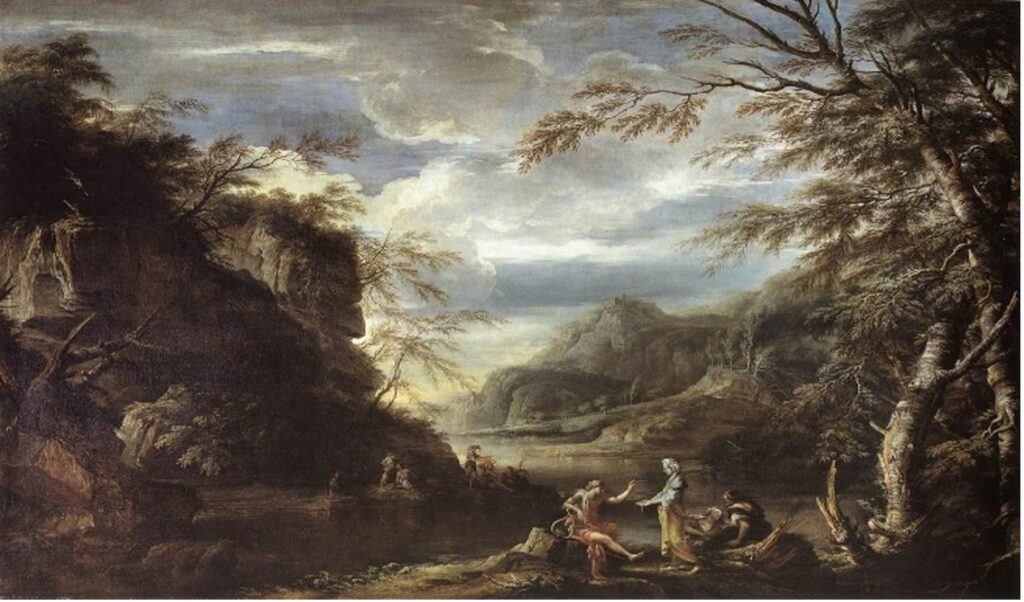
The tree’s branches are dramatically broken, and crushed, with fragmented bark. Freedom-seeking extravagant painter had many friends a d enemies, poet and actor
We could guess that here, for a short time ago harried a terrible storm.
The whole painting is dominated by the dramatic clouds and darkening, brownish sky. If we follow the tallest tree’s trunk we reach naked, gnarly, partly leafless branches which wind to the left and right.The trees are uneven, shredded profile. The rocks are angular and often geometric forms, In the background, we see the last more weak, frail trees whose branches bow to the central part of the painting as if the wind whipped them. The colors cooler nuances such as blue, brown, green, and dark brown. The contrast between the dark brown and the blue creates a dramatic atmosphere.
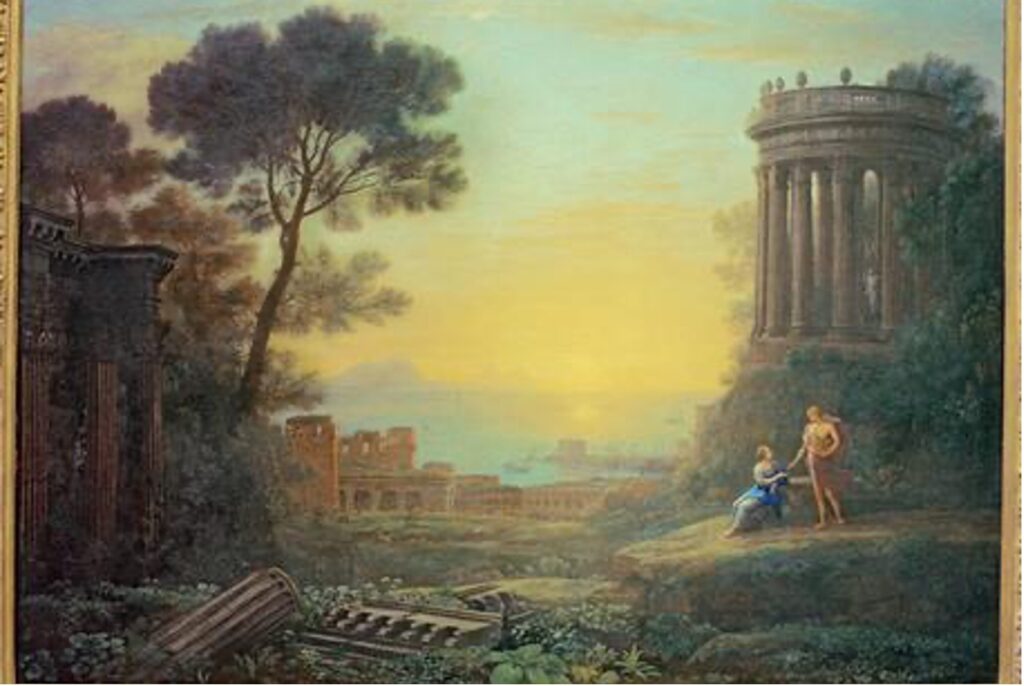
Claude Lorrain, Coastal Landscape with the Cumaean Sibyl, 1655
The central part is open to the clouds and the sun; it’s probably the sunrise. Innovative through painting the sun as a source of light, imaginary buildings, inspired by Roman villas and ancient ruins, and sometimes anachronisms, especially regarding painting ships that were up to date, without architecture rigour. The transition between trees is diffuse, mild and unclear and the transition between the greens of the trees and the sky is indistinct, to the right, we can see the statue of Vesta with the burning torch.
The distribution of objects is mostly symmetrical; ruins with the trees to the left are in balance, and the highest part of the painting is strongly lightened. However, the strongest light falls on the figures of Apollo and Sibyl. Both Apollo and Sibyl bear classical features.
Baroque sublime
Other contemporary authors were for instance Daniello Bartoli, a Jesuit scientist who also thought rhetoric and in his popular The Man of Letters he defined sublime style as something that seizes the soul of those who ‘hear’ it through the power of images and words. Bartoli balances the concept of uniting horror with delight, Concordia discords, Discordia concords. 17th-century imaginations the violence of elements presents a new aesthetic pleasure. By 1650 Poussin, Rosa and Lorrain started painting rocky mountain ridges, vast sceneries of lakes and forests dark clouds and wat, and sunsets. Claude Lorrain is a representative of the ideal landscape inspired by Vergilius and the myth about the Golden Age in the past, in contrast to the Golden Age in the future that Christen doctrine is looking at. We can see the distant unrutted
water, calm luminous sky image of the perfect harmony between man and nature however we can feel that this perfection can’t last longer than an eye blink.
Such an ideal, idyllic atmosphere Claude used to pain mostly after his 60this as this painting was created when he was 65 years old. However, we could also interpret Literary sources that contributed to the popularity of presenting power and mysterious horror of nature on one hand and the silence and spirituality of the divine.
Additionally, the Christian context in the image of hermits in the wild and harsh landscape contributed to the connection of the sublime with spirituality, the painting of Nicolas Poussin( Landscape with S:t Jerome, dramatically lightens up the naked body of the hermit pointing to the cross and a can observe the skull, memento mori, dwarfed by the dark vegetations and tree branches and in the horizon, we can see the lightning
Lorrain’s motif through the Christian doctrine. We could see Sibyl wishing to live eternal life whereas Apollo could be associated with Christus and Sibyl with Maria Eclesia. According to Diane Russel, however, could we see this interpretation as valid?
How can we place it in the 17th-century context? In this century we find both Biblical and motifs brought from the Greek and mythology. I our case the landscape as a background opens assassination to various directions:, Sibyl has had long time a connection to the Christianity .
Classical concept of beauty