
Dignity is a phenomenon that crosses several historical eras and cultural perspectives. Polish and European history of thought highlight the notion of human dignity. This project explores some key elements in the concept of universality of human dignity connecting current discussion regarding the foundation for human rights explored through the lenses of art.
The booklet will be divided in 10 chapters in which of them, I will include one piece of artistic expression beginning with the Ancient Greece and ending in 21st century. The artefacts will be connected and interwoven with the philosophical inquiry regarding the concept of human dignity in each epoch. The interdisciplinary character of this project will facilitate understanding and deeper comprehending both the ethical principle of human dignity but also generally the historical and cultural background of a particular historical period.
Various art expressions such as paintings, sculpture or architecture are inevitably connected to philosophical and cultural discourses regarding every epoch. Human moral and ethical condition had been portrayed through the centuries of European and worlds art. One of the greatest examples of the dignity could be in Greek classical sculptures presenting the concept of pathos, a dignified suffering when the figures remain controlled by the reason during the emotional upheaval.
A later example could be Eugenie Delacroix Liberty Leading the People depicting the heroic effort of men and women during July Revolution of 1830, fighting for the liberty, which is one of the crucial components of human dignity.
The project explores this topic using the fundamental process of philosophical analysis and employing the hermeneutic method of inquiry through texts and image exegesis.

Eugene Delacroix, Liberty Leading the People 1830, Louvre, Paris
The reason to undertake this project was to contribute to the polemic where several contemporary voices contest and criticize the concept of dignity and human rights as being old-fashioned, useless, or the product of European imperialism.
Human dignity as being universality concept, stating that all humans in the world possess inherent dignity regardless of the space and time is very crucial to support during the current global crisis. We are daily exposed to engage with the Russian aggression war on Ukraine witnessing terror attacks on civilians, schools, and hospitals. Unfortunately we had to conclude that the concept of dignity and dignity violations are not old fashioned and useless; on the contrary, they are very current, and vital to withstand in the globalized world with different economic, political, and military issues and conflicts.
Several Articles in the Universal Declaration of Human Rights, including human dignity as a foundation, have been violated during these wars. To defend human dignity and the necessity of human rights and their legal consequences is to support actions that combat all forms of violation against human dignity and worth. One of the active undertakings is writing this booklet and spreading the awareness of the threat of human rights violations.
The concept of human dignity can be connected to cosmopolitan theories concerning human rights and universal human status, which the Stoics have pointed out already in Antiquity.
In this project I will briefly overview the ideas, discourses, and challenges regarding the ontic concept of human dignity and human rights. Seen in the context of different historical epochs within European and World history.
AUSTRALIA 1960th
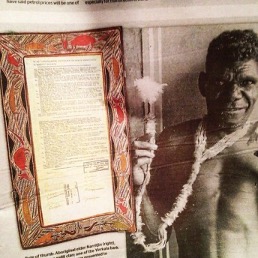
Art and law in one document, Yirrkala Bark Petition, 1963
In August 1963 two bark petitions were delivered to the Australian Parliament’s House of Representatives. This was a formal attempt by the Yolngu to have their land rights recognised.
It was also the first-time documents incorporating First Nations ways of representing relationships to land were recognised by parliament.
Indigenous people’s connection to the land, their stories, and spiritual practices, embraces the inherent value of their communities and stories. The art of these cultures provides a form of resistance against colonial and post-colonial oppression, having as a goal to maintain and enhance Indigenous practices, ways of life and ancient mythology. Regarding contemporary Australian Indigenous art, I will present among others, two great Indigenous artists, Tracey Moffat and Richard Bell. They include the topic of human dignity in their works that address issues such as, gender, equality and race, Often times they challenge the social norms and bring recognition to the marginalization of minority groups, while also celebrating the resilience and of those affected. The painting of Tracy Moffat.

Tracy Moffat, Birth certificate, 1962.